

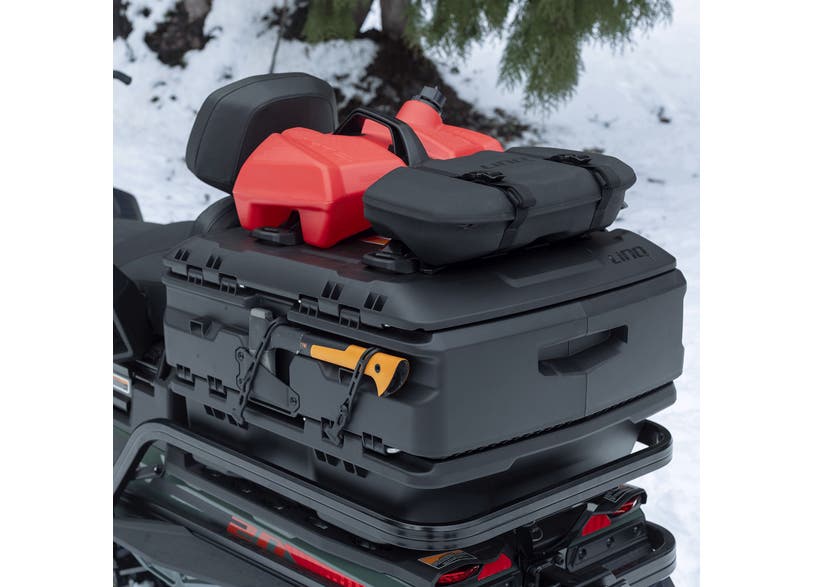
Ski-Doo Fuel Caddy Buyer's Guide: LinQ 11 L, 14 L, 14.5 L & 20 L — Which One Is Right for You?
Every sledder has a version of the same story. You're 40 kilometres past the last open gas station, the temperature is dropping, your buddy's Summit is running a Turbo R and drinking like it, and someone says the words nobody wants to hear on a Sunday afternoon in February: "I think I'm on reserve."
A Ski-Doo fuel caddy is the cheapest insurance against that conversation. It's a purpose-built fuel container that locks onto the LinQ mounting points already on your tunnel, carries between 11 and 20 litres of gas, and comes off in about three seconds when you don't need it. We carry four of them, and the right one depends almost entirely on how far you ride from pavement — not on which is biggest.
Here's how the lineup breaks down, what the mounting hardware actually does, and how to pick.
Do You Actually Need a Ski-Doo Fuel Caddy?
Honest answer: a lot of riders don't.
If you ride groomed OFSC trails in southern and central Ontario, stay on the marked system, and your day is built around trail-town stops, you're rarely more than 60 to 80 kilometres from fuel. Your factory tank covers that comfortably. Adding 20 litres of gas to your tunnel is weight and money you don't need.
A fuel caddy earns its place when one of these is true:
- You ride the northern trail systems — Cochrane, Hearst, Chapleau, Gogama, Abitibi — where the gap between fuel stops stretches well past what a stock tank likes, and where a station being closed on a Sunday is a genuine problem, not an inconvenience.
- You ride deep snow. A Summit or Freeride working hard in untracked powder burns fuel at a rate that makes trail-riding math irrelevant. Boondocking range is a different number entirely.
- You ride a turbo. The 850 E-TEC Turbo R is a wonderful thing and it is not shy about fuel.
- You ride remote, or you ride last. Being the sled that runs dry 30 km from the truck is a group problem, not a personal one.
If none of that describes your season, buy a tunnel bag instead and spend the difference on gear. If two or more do, keep reading.
How the LinQ System Works — and What Those Part Numbers Mean
LinQ is BRP's quick-attach mounting system. It's a pair of anchor points on your tunnel and a matching pair of latches on the accessory. You drop the accessory on, turn the latches, and it's locked. No straps, no bungees, no tools. The same system runs across Ski-Doo, Can-Am and Sea-Doo, which is why some of the caddies below carry more than one brand name in the title — the hardware is genuinely shared.
Three terms are worth decoding before you shop:
- LinQ base — the anchor point bolted into your tunnel. Most modern Ski-Doo sleds come with these already installed from the factory. Older sleds and some trims need a base kit added.
- Stackable — a caddy with LinQ anchor points moulded into its top as well as latches underneath, so a second accessory can mount on top of it. If you want a fuel caddy and a tunnel bag in the same footprint, stackable is the feature that makes it possible.
- T-lock — the plastic latch mechanism itself. It's a wear part. Ski-Doo sells left and right repair kits separately, which tells you how routine replacing them is.
The long numbers in our product titles — 860202247, 715007822, 295100950 — are BRP part numbers. If you're cross-referencing against a manual, an OEM parts catalogue, or a fitment list, that's the number to match on.
The Four Fuel Caddies We Carry, at a Glance
Before the detail, here's the quick comparison:
- Ski-Doo LinQ Fuel Caddy, 3 US Gal (11 L), 860202247 — smallest and lightest. Not stackable. Best for trail riders who want a reserve, not a second tank.
- Ski-Doo/Can-Am LinQ Stackable Fuel Caddy, 3.7 US Gal (14 L), 860202246 — stackable, mid-capacity, Ski-Doo and Can-Am fitment. Best for deep-snow riders carrying gear as well as fuel.
- Sea-Doo LinQ Stackable Fuel Caddy, 3.8 US Gal (14.5 L), 295100950 — stackable, marginally larger, shared across the BRP platforms. Best if you run a Sea-Doo or Switch in summer and want one caddy for both seasons.
- Sea-Doo/Ski-Doo LinQ Fuel Caddy, 5 US Gal (20 L), 715007822 — by far the most capacity, and currently the lowest price of the four. Best for long-range and backcountry riding.
Notice the last one. The 20 L caddy holds nearly double the 11 L and costs less than either stackable. If raw range per dollar is what you're after, the decision is straightforward — the trade-off is bulk and weight on the tunnel, not price.
Ski-Doo LinQ Fuel Caddy, 3 US Gal (11 L) — The Everyday Choice
This is the Ski-Doo fuel caddy most trail riders should buy. Eleven litres is a meaningful reserve — enough to turn "we might not make it" into "we'll make it" — without turning your tunnel into a fuel depot. It's the lightest of the four, it sits low, and you barely notice it's there until you need it.
It's also our deepest-stocked caddy, which is usually a reliable signal about what riders actually choose.
[PRODUCTS]
linq-fuel-caddy-3-gallons
[ENDPRODUCTS]
The one limitation: it isn't stackable. If your tunnel plan involves a bag sitting on top of the caddy, look at the 14 L or 14.5 L instead.
Ski-Doo/Can-Am LinQ Stackable Fuel Caddy, 3.7 US Gal (14 L) — The Deep-Snow Pick
Fourteen litres in a case designed to have something else mounted on top of it. For deep-snow and backcountry riders this is usually the right shape of compromise: enough fuel to extend a real day of boondocking, and you don't surrender your cargo space to get it.
The Ski-Doo and Can-Am fitment in the title is genuine — the same caddy moves between a sled tunnel and a Can-Am rack, which is worth knowing if you ride both.
[PRODUCTS]
ski-doo-can-am-linq-stackable-fuel-caddy-3-7-gallons-14-l
[ENDPRODUCTS]
Sea-Doo LinQ Stackable Fuel Caddy, 3.8 US Gal (14.5 L)
Functionally very close to the 14 L, with a half-litre more capacity and a Sea-Doo part number. It's stackable, and because LinQ is shared across the BRP platforms, it moves between a Ski-Doo tunnel in February and a Sea-Doo Switch pontoon in July.
That dual-season use is the real argument for this one. If you're a BRP household running a sled and a watercraft, buying one caddy that serves both is a sensible piece of thinking.
[PRODUCTS]
sea-doo-linq-14-5l-fuel-caddy-295100950
[ENDPRODUCTS]
Sea-Doo/Ski-Doo LinQ Fuel Caddy, 5 US Gal (20 L) — Most Range Per Dollar
Twenty litres. This is the one for riders going genuinely remote — multi-day trips, northern loops with long unserviced stretches, or hauling fuel out to a camp. On most sleds it represents well over half a second tank, which changes what routes are available to you.
It's also the least expensive caddy in the lineup, which makes the value case unusually clear.
[PRODUCTS]
sea-doo-linq-20l-fuel-caddy-715007822
[ENDPRODUCTS]
Be realistic about the trade-off. Twenty litres of gasoline weighs roughly 15 kilograms before you count the caddy, and that weight sits high and rearward on the tunnel. On a tight, technical trail you will feel it. On a long straight run north, you won't care.
Mounting Your Ski-Doo Fuel Caddy: Bases, Racks and Retrofit Kits
A caddy is only half the purchase. It needs LinQ anchor points to latch onto, and whether you already have them depends on your sled.
Most current Ski-Doo models ship with LinQ bases installed. If yours doesn't, or you're adding a second mounting position further forward or back on the tunnel, the LinQ Base Installation Kit is the standard starting point — and at 152 units on the shelf, it's the part we sell most often alongside caddies.
[PRODUCTS]
linq-base-installation-kit-860201806
linq-cargo-base-kit
[ENDPRODUCTS]
Skandic Sport owners are the notable exception. That model needs the Multi LinQ Plate Retrofit Kit to get a proper multi-position LinQ tunnel, which is a bigger job than a single base kit but opens up the whole accessory range.
[PRODUCTS]
multi-linq-plate-retrofit-kit
[ENDPRODUCTS]
If your tunnel is already full, a rack gives you somewhere else to put the caddy. The LinQ Lightweight 1 + 1 Rack adds mounting real estate without much weight penalty, and the LinQ Universal Rack is the option for mounting BRP LinQ accessories on a non-BRP sled.
[PRODUCTS]
linq-1-1-rack
linq-universal-rack
[ENDPRODUCTS]
For longer-tunnel Gen 4 sleds, the dedicated cargo rack kits come in 146-inch and 154-inch versions — match the kit to your track length, not to your model name.
[PRODUCTS]
cargo-rack-kit-146-gen4
cargo-rack-kit-154-gen4
[ENDPRODUCTS]
Two more parts worth knowing about before you need them. The base plates on the caddy itself are replaceable, and the rubber latches that hold LinQ accessories down are a service item that stiffens and cracks after enough cold cycles.
[PRODUCTS]
linq-fuel-caddy-replacement-base-plates
rubber-latch-service-kit-for-linq-tunnel-accessories
[ENDPRODUCTS]
If a T-lock latch breaks mid-season, it's sold as a left-side and right-side repair kit rather than a whole new caddy. Check which side failed before ordering.
[PRODUCTS]
linq-repair-kit-left-side-t-lock-plastic
linq-repair-kit-right-side-t-lock-plastic
[ENDPRODUCTS]
And if your caddy sits slightly proud or rocks on the base, shims are the correct fix rather than overtightening the latch.
[PRODUCTS]
shims-for-linq-accessories
[ENDPRODUCTS]
You can browse the full range in our Ski-Doo LinQ mounting and hardware collection.
Locking It Down
A LinQ latch is designed for speed, which means anyone can remove your fuel caddy as quickly as you can. In a trail-town parking lot or a hotel lot overnight, that matters. LinQ locks replace the standard latch handle with a keyed one, and the two-pack covers both latches on a single accessory.
[PRODUCTS]
linq-lock-pack-of-2
[ENDPRODUCTS]
The other half of fuel security is the sled itself. A lockable fuel cap stops the most opportunistic kind of theft, and on a long trip it's a reasonable thing to have.
[PRODUCTS]
lockable-vehicle-fuel-cap
[ENDPRODUCTS]
Fuel Care and Off-Season Storage
Gas carried in a caddy sits longer than gas in your tank, and Canadian pump fuel contains ethanol, which attracts moisture and separates over time. In a caddy going through repeated freeze-thaw cycles in an unheated garage, that's a real concern, not a theoretical one.
XPS Fuel Stabilizer is ethanol-compatible and designed for exactly this — treat the fuel as you fill the caddy rather than after it's been sitting.
[PRODUCTS]
xps-fuel-stabilizer-9779171
[ENDPRODUCTS]
At the end of the season, empty the caddy into your truck or your sled rather than storing fuel in it over the summer. Leave the cap slightly loose in a ventilated space so pressure can equalise through temperature swings, and give the seal a wipe before the first ride of the next season.
A note on filling: never fill a fuel caddy while it's still latched to a warm sled, and let a caddy that's been outside all day equalise before you open it in a heated space. Basic stuff, but worth saying.
Stacking the Rest of Your Tunnel Load
If you bought a stackable caddy, this is where the payoff arrives. The SR tunnel bag is the common pairing — 21 litres of soft storage sitting directly on top of the fuel caddy in the same tunnel footprint.
[PRODUCTS]
sr-5-5-gal-21l-linq-bag
[ENDPRODUCTS]
For riders who'd rather carry tools and spares than clothing, the LinQ tool box is a hard-sided alternative that handles being dropped in the snow rather better than a bag does.
[PRODUCTS]
linq-tool-box
[ENDPRODUCTS]
There's more in the Ski-Doo LinQ racks, bags and storage collection if you're building out a full touring setup.
Which Ski-Doo Fuel Caddy Is Right for You?
Short version:
- Groomed trail riding, want a reserve — the 11 L, 860202247. Lightest, simplest, most popular.
- Deep snow, carrying gear too — the 14 L stackable, 860202246. Fuel and cargo in one footprint.
- You also run a Sea-Doo or Switch — the 14.5 L stackable, 295100950. One caddy, two seasons.
- Remote riding, multi-day, or hauling to camp — the 20 L, 715007822. Most range, best value, most weight.
Budget-wise, expect roughly $210 to $240 for an entry caddy, $290 to $310 for a stackable, and another $50 to $150 on top if you need a base kit, a rack or locks. A complete first-time setup — caddy, base installation kit and a two-pack of locks — lands around $440 to $510 in CAD.
Still not sure which fuel caddy suits your sled and your riding? Give us a call or send an email — we ride these trails too, and we'd rather spend five minutes getting your fitment right than have you order the wrong base kit. You can also browse the full LinQ fuel caddy collection or the wider Ski-Doo LinQ storage range to compare side by side. We ship Canada-wide.

Leave a comment
This site is protected by hCaptcha and the hCaptcha Privacy Policy and Terms of Service apply.