

Whether you're repowering a 14-foot aluminum tiller boat, hanging a kicker on the transom of a walleye rig, or buying your first portable for the cottage dock, the same question comes up: two-stroke or four-stroke?
For nearly every recreational boater in Canada today, a 4-stroke outboard is the right answer. Four-stroke outboards burn noticeably less fuel, run quieter, produce far fewer emissions, require no fuel-oil mixing, and are effectively the only gas outboards still built for new recreational sale in North America. Two-strokes are lighter and mechanically simpler, and a well-maintained one is still perfectly legal to own and operate in Canada — but they now live almost entirely on the used market.
Below is the full comparison: how each engine works, what the real-world differences feel like on the water, what the Canadian rules actually say, and how to pick the right motor for your hull.
4-stroke vs 2-stroke outboard: the quick comparison
Here's how the two designs stack up on the factors that matter to a recreational boater:
- Weight: 2-stroke wins. A two-stroke is typically 10–20% lighter than a four-stroke of the same horsepower, because it has no valvetrain, camshaft, or oil sump.
- Fuel economy: 4-stroke wins, clearly. Expect roughly 30–40% better fuel burn than a carbureted two-stroke of the same power, and no separate oil purchase.
- Noise and smell: 4-stroke wins. No blue haze, no two-stroke oil smell, and a much lower-pitched idle.
- Low-speed trolling: 4-stroke wins. It idles cleanly for hours without loading up or fouling plugs.
- Acceleration per pound: 2-stroke wins. It fires on every crankshaft revolution, so it hits its power band fast.
- Routine maintenance: Roughly a wash. A four-stroke needs oil and filter changes; a two-stroke needs oil mixed or topped up constantly and burns plugs faster.
- Buying new: 4-stroke only. New carbureted two-stroke outboards are no longer manufactured, imported, or sold for recreational use in North America.
How a 2-stroke outboard works
A two-stroke engine completes a full power cycle in two piston strokes — one crankshaft revolution — so it produces a power stroke every single revolution. Intake and exhaust happen through ports in the cylinder wall rather than through valves, which is why a two-stroke has no camshaft, no timing chain, and no valve train to service.
Lubrication is the defining difference. A two-stroke doesn't have a sealed oil sump. Instead, oil is mixed with the gasoline — either pre-mixed in the tank at a ratio like 50:1, or metered in automatically by an oil-injection system — and that oil is burned along with the fuel. Two-stroke outboards require a marine-specific oil carrying the NMMA TC-W3 certification, not automotive or air-cooled two-stroke oil.
The tradeoff is scavenging loss: during the brief window when the intake and exhaust ports are both open, some raw fuel-oil mixture escapes straight out the exhaust unburned. That is the source of both the blue smoke and the fuel-economy penalty on older carbureted two-strokes.
What direct injection changed
Direct-injection (DFI) two-strokes — Mercury OptiMax and Evinrude E-TEC being the two most common in Canada — solved that problem by injecting fuel into the cylinder only after the exhaust port has closed. That kept unburned fuel out of the water and let those engines meet modern emissions standards. Both lines have since been discontinued: Mercury ended OptiMax outboard production in 2018, and BRP ceased Evinrude E-TEC production in 2020.
How a 4-stroke outboard works
A four-stroke engine takes four piston strokes — two crankshaft revolutions — to complete one power cycle: intake, compression, power, exhaust. Poppet valves operated by a camshaft control the flow in and out of the cylinder, so intake charge and exhaust gas never mix. Nothing goes out the exhaust except burned combustion products.
Oil lives in a dedicated crankcase sump, exactly like a car engine, and it lubricates rather than burns. You put straight gasoline in the tank. Four-stroke outboards use marine four-stroke oil meeting the NMMA FC-W specification, which is formulated for the corrosion and moisture conditions marine engines actually see.
Modern four-strokes also brought electronic fuel injection down into small displacements. Mercury's EFI portables, for example, start reliably cold, hold a steady idle, and compensate automatically for altitude and temperature — things a carbureted engine of either type never did well.
Weight: the one place 2-strokes still lead
A two-stroke has fewer parts, so it weighs less. On small portables the gap matters most: a difference of 15 to 25 pounds on a 9.9 hp motor is a real consideration if you're lifting the engine off a transom and carrying it to a car trunk, or if you're running a small hull with a tight transom weight rating.
Three practical notes on weight:
- Check your transom capacity plate. Every boat has a maximum motor weight as well as a maximum horsepower. Repowering an older hull that was designed around a light two-stroke can push you past that rating.
- The gap narrows as horsepower climbs. At mid and large horsepower, modern four-stroke powerheads have closed most of the weight difference against the DFI two-strokes they replaced.
- Weight on the transom changes how the boat sits. Extra stern weight on a small tiller boat affects planing attitude and how the hull behaves in a following sea, especially with passengers aft.
Fuel economy and real running costs
Four-stroke outboards use meaningfully less fuel than carbureted two-strokes — commonly 30–40% less over a season of mixed running — because no raw fuel escapes during scavenging. On a boat that burns a few hundred litres a summer, that difference alone often exceeds the price gap between a used two-stroke and a new four-stroke over a handful of seasons.
The oil math matters too. A two-stroke consumes oil continuously as a running cost; you're buying TC-W3 oil all season long. A four-stroke buys oil twice a year at most, and the same fill lubricates the engine for the full service interval.
Where the two-stroke wins on cost is acquisition. A clean used two-stroke can be bought for a fraction of a new four-stroke, which is exactly why they remain popular on small utility boats, hunting punts, and backup kickers.
Noise, smoke, and what your passengers notice
This is the difference people feel first. A four-stroke idles at a low, steady rumble with no visible exhaust and no oil smell. A carbureted two-stroke idles with a distinctive ring-a-ding, hazes at start-up, and leaves the two-stroke smell on your clothes.
For anyone who fishes, that's not just comfort — it's a functional advantage. A four-stroke will troll at low rpm for hours without loading up, fouling plugs, or filling the cockpit with exhaust when you're drifting downwind. Two-strokes historically hated sustained low-rpm running, and plug fouling on trolling motors was a familiar service complaint.
Maintenance and service intervals
Four-stroke maintenance is more like car maintenance: change the engine oil and filter, change the gearcase lube, replace the water pump impeller on schedule, and check the anodes. Mercury FourStroke outboards typically call for an initial 20-hour break-in service, then oil and filter service every 100 hours or annually, whichever comes first — always confirm the interval in your model's owner's manual.
Two-stroke maintenance skips the oil change entirely, but adds its own list: mixing fuel correctly (or keeping the oil-injection reservoir topped and the system verified), replacing spark plugs more often, decarbonizing the exhaust, and cleaning carburetors that gum up over a Canadian off-season.
For Ontario boaters specifically, the off-season is the maintenance event that matters. Both engine types need fuel stabilizer and fogging before storage, and both need the gearcase lube drained and inspected for water intrusion before the boat sits through a freeze. A four-stroke adds one more step: change the engine oil before storage, not after, so acidic combustion byproducts aren't sitting in the sump all winter. We stock Mercury Marine oil change kits matched by engine family, along with a broader range of Mercury Marine maintenance kits for water pump, gearcase, and annual service.
What Canadian emissions rules actually say
Marine engine emissions in Canada are governed by the Marine Spark-Ignition Engine, Vessel and Off-Road Recreational Vehicle Emission Regulations (SOR/2011-10), which align Canadian standards with U.S. EPA requirements. Here is what that means in practice:
- Owning and running an older two-stroke is legal. There is no federal ban on operating a carbureted two-stroke outboard you already own, and you can buy and sell them on the used market.
- Manufacturing, importing, and selling new carbureted two-stroke recreational marine engines is not permitted. That's why no dealer in Canada can order you a new one.
- Some waters have their own rules. Certain national parks, conservation areas, and municipal or lake-association restrictions limit motors to four-stroke or direct-injection two-stroke only. Check before you launch somewhere new.
The practical upshot: if you're buying new, the decision is already made for you. If you're buying used, a DFI two-stroke like an E-TEC or OptiMax will pass emissions-restricted waters that an older carbureted motor won't.
When a 2-stroke still makes sense
A used two-stroke is still a defensible buy in a few specific situations:
- You need the lightest possible motor. Car-topping a small boat solo, or portaging, where every pound counts.
- The budget is tight and the use is light. A cottage utility boat that runs 10 hours a season doesn't recover a new-motor premium through fuel savings.
- You already own one that runs well. A healthy two-stroke with good compression and available parts is worth maintaining rather than replacing on principle.
The counter-consideration is parts. With E-TEC and OptiMax both out of production, some components are getting harder to source, and that trend continues. Factor parts availability into any used purchase of a discontinued platform.
Which outboard should you buy?
Matching the motor to how you actually use the boat:
- Small aluminum tiller boat or cottage runabout (2.5–20 hp): A four-stroke portable. Simple, quiet, no mixing, and light enough to handle. Mercury's portable FourStroke range covers this segment from 2.5 hp up through 20 hp.
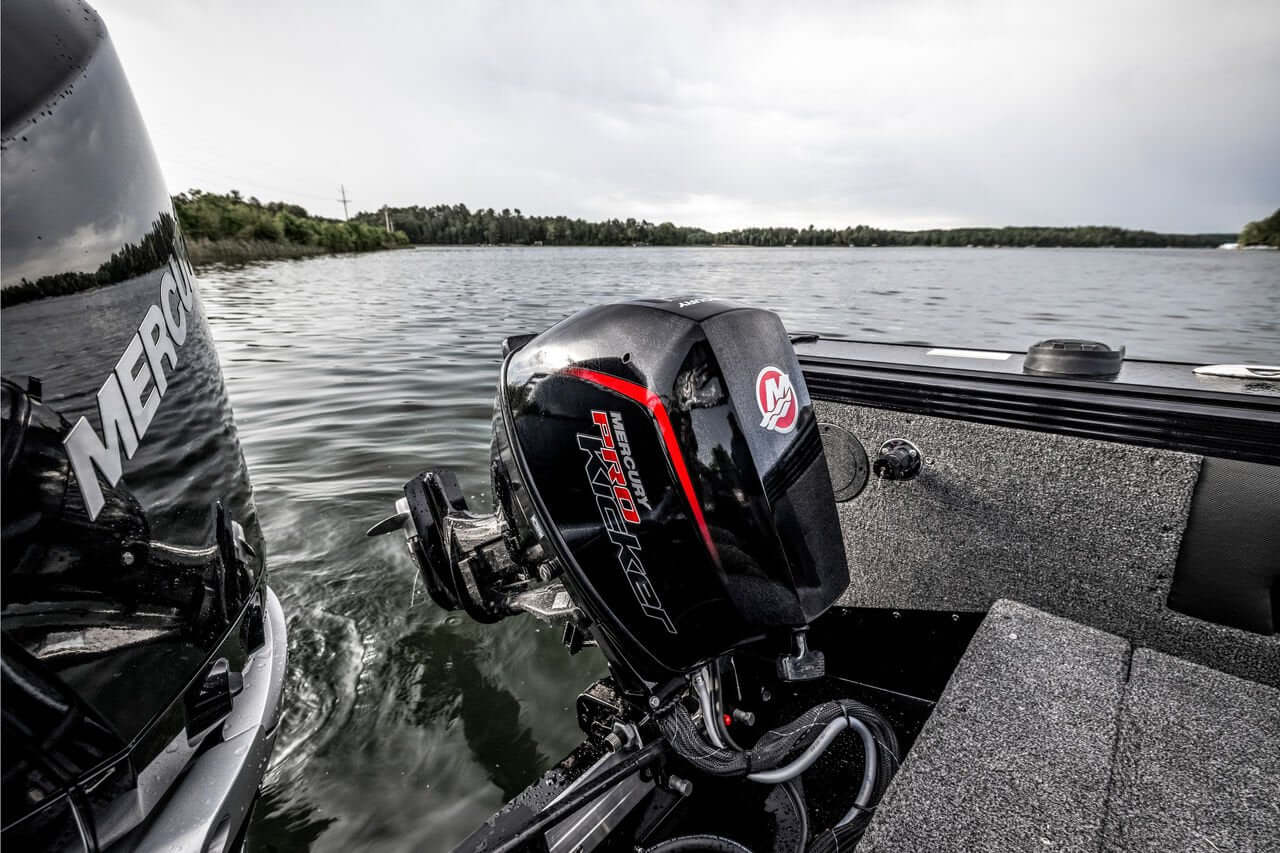
- Kicker or trolling motor on a fishing boat (8–15 hp): A Command Thrust four-stroke. The 2026 Mercury 9.9ELHPT Command Thrust ProKicker EFI FourStroke is a 20-inch long-shaft, electric-start, tiller-handle motor with power trim, designed as a kicker for aluminum and fibreglass fishing boats and as auxiliary power on larger hulls — its larger gearcase and high-thrust propeller are built specifically for sustained low-speed trolling.
- Pontoon or family runabout: A mid-range four-stroke. Torque, quiet operation at cruise, and clean idling matter more than raw power-to-weight when there are people on board.
- Quiet lakes, electric-only waters, or a tender: Consider electric. The 2026 Mercury 7.5 ELH Avator delivers roughly the equivalent of a small gas portable with no fuel, no oil, and no exhaust at all.
Talk to a dealer before you commit
Horsepower is only one of the specs that has to match. Shaft length has to suit your transom height (15-inch short, 20-inch long, and 25-inch extra-long are the common options), the control type has to match how you drive, and the propeller has to be pitched to let the engine reach its rated wide-open-throttle rpm range with a typical load aboard. A motor that's right on paper and wrong on shaft length or prop pitch will underperform every trip.
Energy Powersports is a Mercury Marine dealer in Oakville, Ontario, serving boaters across the GTA and shipping parts Canada-wide. You can browse our current Mercury outboard motors online, or call the shop and we'll help you match shaft length, control setup, and prop to your hull.

Leave a comment
This site is protected by hCaptcha and the hCaptcha Privacy Policy and Terms of Service apply.