

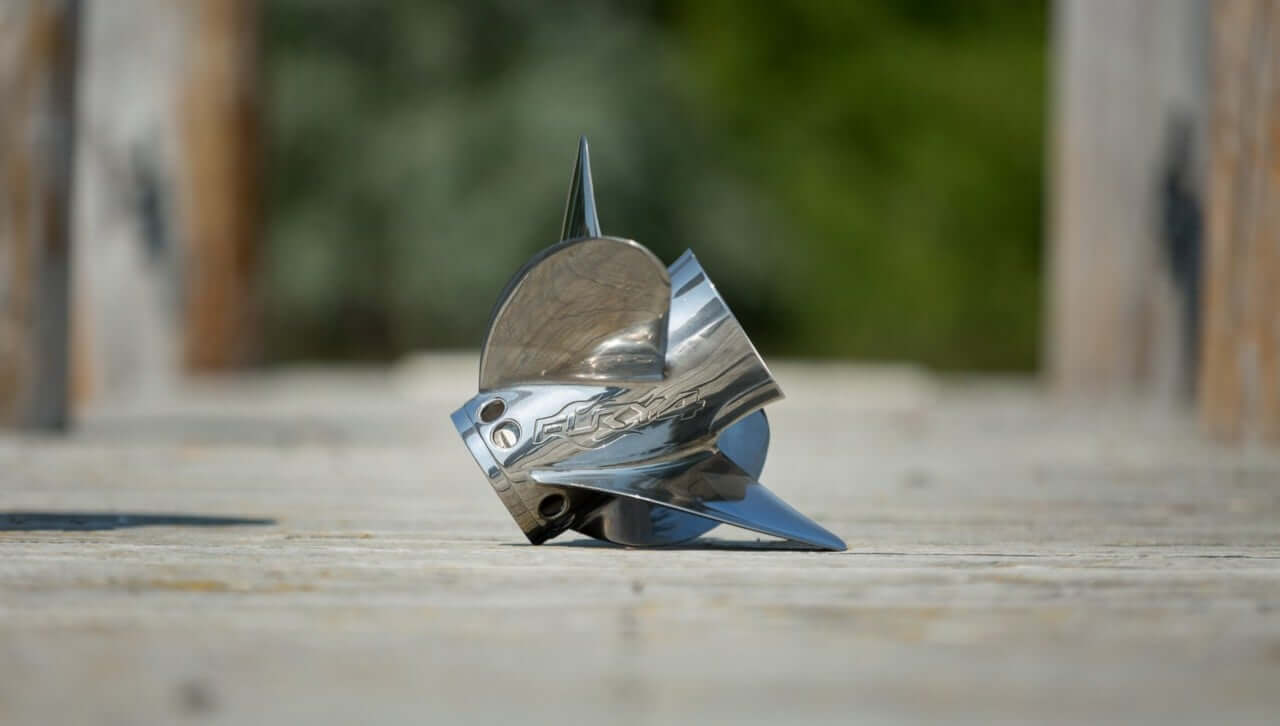
Buying a boat propeller should be simple. You have an engine, you need a prop, how hard can it be?
Then you start shopping and you run into numbers like 14 x 19, terms like "15-spline," a warning that a hub kit is sold separately, and a note that a prop fits the Command Thrust gearcase but not the standard one — even though both engines say 115 on the cowling.
This guide unpacks all of it. By the end you will know exactly which measurements matter, where to find them on your own boat, and how to tell the difference between a prop that fits and a prop that is right. No jargon left unexplained.
The short answer
A propeller fits your outboard if four things line up: your gearcase, your spline count, your prop shaft diameter, and the hub system that connects the two. Your engine's horsepower and model year do not determine fitment on their own — two 115 hp outboards from the same year can take completely different props.
Once you know a prop will physically fit, diameter and pitch determine how your boat actually performs. Diameter is how much water the blades grab. Pitch is your boat's gearing.
Fitment is really two separate questions
Almost every propeller mistake comes from blurring two questions that deserve separate answers:
- Will it physically bolt onto my engine? This is a yes or no. Get it wrong and the prop either will not go on, or it goes on and destroys something expensive.
- Is it the right prop for my boat and how I use it? This is a matter of degree. Get it wrong and the boat still runs, it just runs badly — sluggish out of the hole, or screaming at the top end without going anywhere.
Answer question one first. There is no point comparing pitch options among props that were never going to fit in the first place.
Question 1: Will it physically fit?
Your gearcase — the part that matters most
The gearcase (also called the lower unit) is the torpedo-shaped housing at the bottom of your outboard, below the water line. It contains the gears and the shaft your propeller mounts to.
This is the single most important thing to identify, and it is the one people most often get wrong. Manufacturers fit different gearcases to engines that otherwise look identical. Mercury alone offers standard gearcases in a few sizes, plus Command Thrust, BigFoot, Torque Master and heavy-duty versions.
Here is why it matters in practice: a Mercury 115 hp with a standard gearcase and a Mercury 115 hp with a Command Thrust gearcase are different fitments. Same brand, same horsepower, same year. The Command Thrust unit is physically larger, spins a bigger prop, and takes different hardware. A prop listed for one will not work on the other.
Command Thrust and BigFoot gearcases exist because some boats — pontoons and heavy family boats especially — need more grunt than top speed. The larger gearcase turns a larger-diameter prop more slowly, which moves more water and gets a heavy hull onto plane. If you own a pontoon, there is a good chance you have one.
Spline count
Splines are the ridges running lengthwise along your prop shaft, like the teeth of a gear. They are what actually transmits engine torque to the propeller. The prop has matching grooves inside it.
The count has to match exactly. A 13-spline prop will not slide onto a 15-spline shaft — not with force, not with a bigger hammer. Smaller outboards commonly run 10 or 13 splines; many mid-range and larger outboards use 15. Larger high-horsepower engines go higher still.
Do not guess this one. Count them.
Prop shaft diameter
The thickness of the shaft itself. On modern outboards this is usually either 1.00 inch or 1.25 inch. It determines which hub kit you need, and on some props it is the deciding factor between two otherwise identical part numbers.
A useful shortcut: on Mercury engines the spline count and shaft diameter tend to move together, so if you count your splines accurately you can often work backwards to the shaft size. But if you have calipers, just measure.
The hub — the part almost everyone forgets
The hub is the sleeve that sits between the propeller and the shaft. It is not decorative. It does two jobs:
- It adapts one propeller design to many different engines
- It acts as a mechanical fuse
That second job is worth understanding. If you hit a rock or a submerged log at speed, something has to give. The hub is engineered to be that something — it sacrifices itself well below the point where your gearcase would break. A hub costs under a hundred dollars. A gearcase rebuild is thousands.
Mercury's hub system is called Flo-Torq, and it comes in several versions: Flo-Torq II, III and IV, plus the SSR family (SSR, SSR HD, SSR Solid) which uses a soft rubber element to cut down the clunk you hear shifting into gear. There is also Flo-Torq Reflex.
Two things to know:
- Most props do not include a hub kit. It is a separate purchase, and the correct kit depends on your engine, not on the prop. This catches a lot of first-time buyers.
- Hub systems are not interchangeable. Hardware from an older pressed-rubber-hub propeller will not work with a Flo-Torq Reflex propeller, and vice versa.
The upside of a modular hub system: it lets Mercury propellers run on many non-Mercury engines. With the right Flo-Torq kit, a Mercury prop can fit a Yamaha, Honda or Tohatsu gearcase. Cross-brand fitment is real, it just has to be the right kit.
How to find your numbers in five minutes
You need three pieces of information. Here is where to get them.
1. Check the transom tag. There is a metal plate on the transom bracket of your outboard, where the engine mounts to the boat. It lists the model and serial number, and often a gearcase code. Photograph it. This tag is the most authoritative source on your engine, better than the cowling badge.
2. Pull the prop and count the splines. With the engine off and the key out, remove the prop nut and slide the propeller off. Count the ridges on the shaft. Write the number down.
3. Read the numbers stamped on your current prop. Almost every propeller has its size cast or stamped into the hub or a blade. You are looking for two numbers, usually written like 14 x 19 or 14-19. The first is diameter in inches, the second is pitch in inches. There is often a part number too — note that as well.
Those three data points plus a clear photo of the prop shaft answer nearly every fitment question.
Question 2: Is it the right prop for your boat?
Now that you know what fits, here is how to choose among the options.
Diameter — how much water you grab
Diameter is the width of the circle the blade tips sweep out. Bigger diameter means more blade in the water, which means more thrust at low speed and better ability to move a heavy load.
You rarely get to choose diameter freely. It is largely dictated by your gearcase — the housing only has room for so much prop. Treat diameter as mostly fixed and spend your decision-making on pitch.
Pitch — your boat's gearing
This is the concept worth understanding properly, because it is where almost all the performance difference lives.
Pitch is the distance, in inches, that the propeller would travel forward in one full rotation if it were turning through something solid. A 19-inch-pitch prop theoretically advances 19 inches per turn.
The easiest way to think about it is bicycle gears:
- Low pitch = low gear. Easy to get moving, quick acceleration, pulls heavy loads well. But you spin out early and never reach much top speed.
- High pitch = high gear. Harder to get going, slower out of the hole. But once you are moving you go faster for the same engine speed.
Here is the part that trips people up: a boat only has one gear. You choose it once, in the parking lot, and you live with it all day. So the choice is a genuine trade-off, and the right answer depends on how you actually use the boat.
Pull tubes and skiers with a full load of people? You want lower pitch and the acceleration that comes with it. Run light with two people looking for top-end speed on open water? Go higher.
The WOT test — how to know you got it right
You do not have to guess. Your engine manufacturer publishes a recommended wide open throttle (WOT) RPM range — it is in your owner's manual, and it is usually something like 5000 to 5800 RPM.
Load the boat the way you normally run it. Open the throttle all the way, in a safe open area, and read the tachometer.
- RPM above the recommended range? You are over-revving. The prop is not loading the engine enough. Go up in pitch.
- RPM below the recommended range? You are lugging it. The prop is too much load. Go down in pitch.
- RPM inside the range? You are propped correctly.
Running outside that range is not just a performance issue. Over-revving and lugging both shorten engine life.
The conversion rate is roughly 150 to 200 RPM for every inch of pitch, in the opposite direction — add pitch, RPM drops.
A worked example
Say your engine's recommended WOT range is 5000 to 5800 RPM. You currently run a 14 x 17 prop, and at full throttle with your usual load you are hitting 6100 RPM.
You are 300 RPM over the top of the range. At roughly 150 to 200 RPM per inch, moving up two inches of pitch — from 17 to 19 — should pull you down 300 to 400 RPM, landing you around 5700 to 5800. That is inside the range, at the top end, which is a good place to be.
One rule when experimenting: change one variable at a time. If you swap pitch, blade count and material all at once, you learn nothing from the result.
Three blades or four?
| 3-Blade | 4-Blade | |
|---|---|---|
| Top speed | Higher | Slightly lower |
| Acceleration | Good | Better |
| Holding in turns | Good | Better |
| Rough water | More prone to ventilating | Holds bite better |
| Best for | Light boats, top-end speed, fuel economy | Heavy boats, pontoons, watersports, choppy water |
More blades means more blade area in the water. That is more grip, faster planing and better mid-range pull, at a small cost in outright top speed. If you are towing anything or running a pontoon, four blades is usually the better call.
One note if you are switching from three blades to four: if your current three-blade prop already puts you in the right RPM range, start by trying the same pitch in a four-blade. Do not assume you need to change both at once.
Aluminum or stainless steel?
Aluminum is the sensible default for most boaters. It costs considerably less, performs perfectly well below roughly 50 mph, and it is cheap to replace if you clip a rock. Many people keep an aluminum prop as a spare precisely because it is affordable to sacrifice.
Stainless steel is stiffer, so the blades can be made thinner without flexing under load. Thinner blades are more efficient, and a stainless prop holds its shape at speeds where an aluminum one would start to distort. It also survives impacts that would destroy aluminum. You pay several times the price for it.
The honest rule of thumb: if you run under about 50 mph and mostly cruise, aluminum. If you run fast, run often, run in shallow or rocky water, or you are chasing every last bit of performance, stainless earns its price.
Right hand, left hand, and twin engines
Most single-engine boats use a right-hand (RH) propeller, which turns clockwise when viewed from behind the boat. If you have one engine, this is almost certainly what you need.
Boats with twin engines usually run one RH and one left-hand (LH) prop. The two rotations cancel each other out, which removes the steering pull you would otherwise fight all day. If you are replacing one prop on a twin setup, make sure you order the correct rotation for that side — they are not interchangeable.
Why pontoon props are their own category
Pontoons ask something different of a propeller. They are heavy, they carry a lot of people, they have enormous drag from two or three tubes, and they need to get up on plane at modest speed and stay there.
Purpose-built pontoon props — Mercury's SpitFire Pontoon and Quicksilver's Nemesis Pontoon, for example — use blade geometry designed to generate lift and hold plane at lower speeds. They are typically four-blade designs. If you run a pontoon on a general-purpose prop, you will usually find it feels sluggish getting onto plane and wallows at cruising speed.
If you own a pontoon, start with a pontoon-specific prop. It is one of the few upgrades where the difference is obvious on the first run.
Five mistakes we see most often
- Ordering by horsepower alone. "I have a 115" is not enough information. The gearcase decides fitment, and two 115s can be different.
- Forgetting the hub kit. The prop arrives and the customer has no way to mount it. Always confirm whether the hub is included.
- Reusing old hardware. Thrust washers and hardware from an older rubber-hub prop are not compatible with newer Flo-Torq systems. Wrong washer order causes hub slip and premature wear.
- Chasing top speed with pitch. Going up two inches will not make a heavy boat faster if the engine can no longer reach its WOT range. It will make it slower and shorten engine life.
- Assuming pitch numbers compare across brands. Different manufacturers measure differently. A 19 from one brand does not necessarily behave like a 19 from another.
Still not sure? Send us a photo
If any of this is unclear for your specific setup, the fastest path is not more reading — it is a photo.
Pull your prop, take a clear picture of the prop shaft and splines, photograph your transom tag, and note the numbers stamped on your existing propeller. Send all of it to estore@energypowersports.ca or call us at (905) 901-5500, and our parts team will confirm exactly what fits before you spend a dollar.
We would much rather spend five minutes checking than have you install the wrong prop. So would your gearcase.
Browse our Mercury and Quicksilver propellers and our Flo-Torq hub kits. Local pickup and installation are available at our Oakville location - 879 Cranberry ct.


Leave a comment
This site is protected by hCaptcha and the hCaptcha Privacy Policy and Terms of Service apply.